Differences Between Copyright and Trademark in India: A Complete Guide
Posted By: Admin Published: 08-05-2026
- 1. What Is Copyright?
- 2. What Is a Trademark?
- 3. 🔍 Key Differences Between Copyright and Trademark in India
- 4. 📜 Registration Process: Copyright vs. Trademark in India
- 5. 💡 When to Use Copyright vs. Trademark?
- 6. 🚨 Overlapping Cases: Can Something Be Both Copyrighted and Trademarked?
- 7. Legal Remedies for Infringement
- 8. Why Choose Tripathi & Arora Associates for Copyright & Trademark Registration?
- 8.1. ✅ Expert IPR Team
- 8.2. ✅ End-to-End Services
- 8.3. ✅ Fast & Hassle-Free Process
- 8.4. ✅ Affordable Pricing
- 8.5. ✅ Proven Track Record
- 9. Conclusion: Protect Your Intellectual Property the Right Way
- 10. FAQs
- 10.1. Q1. Can I copyright a logo?
- 10.2. Q 2. Can I trademark a book title?
- 10.3. Q 3. What is the difference between ™ and ®?
- 10.4. Q 4. How long does copyright last in India?
- 10.5. Q 5. Can I register a trademark internationally?
- 11. 🔗 Related Services You Might Need
- 12. Other Related Links
In today’s digital and competitive business landscape, protecting your intellectual property (IP) is crucial for brand identity, creative works, and business growth. Two of the most commonly confused forms of IP protection in India are Copyright and Trademark.
While both safeguard intellectual creations, they serve distinct purposes, cover different types of assets, and offer unique legal protections.
At Tripathi & Arora Associates LLP, we help businesses and creators secure their intellectual assets through expert copyright and trademark registration services. In this guide, we’ll break down the key differences between copyright and trademark in India, their scope, duration, registration process, and legal remedies—so you can choose the right protection for your work.
What Is Copyright?
Copyright is a legal right granted to the creator of original literary, dramatic, musical, artistic, or cinematographic works. It protects the expression of ideas—not the ideas themselves—and gives the creator exclusive rights to:✅ Reproduce the work (e.g., printing, copying, recording).
✅ Distribute the work (e.g., selling, renting, or licensing).
✅ Perform or display the work publicly (e.g., concerts, exhibitions, online streaming).
✅ Create derivative works (e.g., adaptations, translations, remixes).
📌 What Does Copyright Protect in India?
Under the Copyright Act, 1957 (amended in 2012), copyright covers:| Category | Examples |
|---|---|
| Literary Works | Books, articles, computer programs, databases, blogs, scripts. |
| Dramatic Works | Plays, choreography, scripts for films or TV. |
| Musical Works | Songs, compositions, lyrics, background scores. |
| Artistic Works | Paintings, sculptures, photographs, logos, architectural designs. |
| Cinematographic Films | Movies, TV shows, documentaries, short films, web series. |
| Sound Recordings | Music albums, podcasts, audiobooks. |
| Software & Multimedia | Mobile apps, video games, animations, digital content. |
❌ Ideas, concepts, or theories (e.g., the idea for a story, not the written story itself).
❌ Short phrases, titles, or slogans (these may be protected under trademark).
❌ Factual information (e.g., news reports, historical data).
❌ Functional or utilitarian aspects (e.g., the design of a useful machine—protected under patent).
What Is a Trademark?
A trademark is a recognizable sign, symbol, word, phrase, logo, or combination that distinguishes the goods or services of one business from another. It protects brand identity and prevents consumer confusion in the marketplace.📌 What Does a Trademark Protect in India?
Under the Trade Marks Act, 1999, a trademark can include:| Type of Trademark | Examples |
|---|---|
| Word Marks | Brand names (e.g., Tata, Amul, Zomato). |
| Logo/Device Marks | Visual symbols (e.g., Nike’s Swoosh, Apple’s bitten apple). |
| Slogan Marks | Taglines (e.g., "Just Do It" (Nike), "The Taste of India" (Amul)). |
| Shape Marks | Product shapes (e.g., Coca-Cola bottle, Toblerone triangle chocolate). |
| Sound Marks | Audio jingles (e.g., Intel’s "bong" sound, Nokia tune). |
| Color Marks | Unique color combinations (e.g., Tiffany Blue, Cadbury Purple). |
| 3D Marks | Three-dimensional designs (e.g., Lego bricks, McDonald’s Golden Arches). |
| Collective Marks | Marks used by members of a group (e.g., "CA" for Chartered Accountants). |
| Certification Marks | Marks indicating quality standards (e.g., "ISI Mark", "FSSAI Logo"). |
❌ Generic terms (e.g., "Computer" for a tech company).
❌ Descriptive terms (e.g., "Sweet" for a candy brand).
❌ Deceptive or immoral marks (e.g., misleading claims about product quality).
🔍 Key Differences Between Copyright and Trademark in India
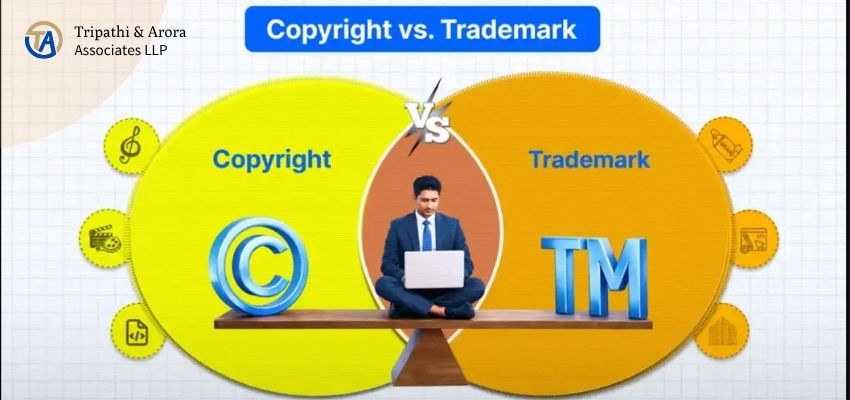
| Feature | Copyright | Trademark |
|---|---|---|
| Purpose | Protects original creative works (e.g., books, music, software). | Protects brand identity (e.g., logos, slogans, product names). |
| Legal Act | Copyright Act, 1957 (Amended in 2012). | Trade Marks Act, 1999 (Amended in 2010). |
| What It Protects | Expression of ideas (e.g., a novel, song, painting). | Source identification (e.g., Nike’s logo, Coca-Cola’s brand name). |
| Symbol Used | © (Copyright symbol). | ™ (Unregistered trademark), ® (Registered trademark). |
| Registration Authority | Copyright Office, Department of Industrial Policy & Promotion (DIPP). | Controller General of Patents, Designs & Trademarks (CGPDTM). |
| Registration Process | Automatic (exists upon creation), but registration is recommended for legal evidence. | Mandatory for full legal protection (common law rights exist but are limited). |
| Duration of Protection | Lifetime of the author + 60 years (for literary, musical, artistic works). | 10 years (renewable indefinitely every 10 years). |
| Renewal | No renewal needed (automatic for the term). | Must be renewed every 10 years (failure to renew leads to cancellation). |
| Infringement | Unauthorized copying, distribution, or adaptation of the work. | Unauthorized use of a similar mark that causes consumer confusion. |
| Remedies for Infringement | Civil suit (injunction, damages, account of profits), criminal charges (rare). | Civil suit (injunction, damages, account of profits), criminal charges (for counterfeiting). |
| Examples | A novel by Chetan Bhagat, a Bollywood movie, a mobile app’s code. | Amul’s logo, Tata’s brand name, McDonald’s "I’m Lovin’ It" slogan. |
📜 Registration Process: Copyright vs. Trademark in India
🔹 Copyright Registration Process
- File Application – Submit Form XIV (for literary/dramatic/musical/artistic works) or Form XIII (for cinematographic films/sound recordings) to the Copyright Office.
- Document Submission – Provide:
- 3 copies of the work (for published works).
- NOC from the publisher (if the work is published).
- NOC from the author (if the applicant is not the author).
- Power of Attorney (if filed through an agent).
- Examination – The Copyright Office checks for originality and compliance.
- Objections (if any) – If objections are raised, the applicant must respond within 30 days.
- Registration Certificate – Issued if no objections or after resolving objections.
- Time Taken: 2–3 months (varies based on objections).
- Fees: ₹500–₹5,000 (depending on the type of work).
- Legal evidence in case of disputes.
- Public record of ownership.
- Right to sue for infringement.
🔹 Trademark Registration Process
- Trademark Search – Conduct a public search on the IP India Website to ensure no identical/similar marks exist.
- File Application – Submit Form TM-A to the Trademark Registry (online via IP India Portal).
- Document Submission – Provide:
- Trademark specimen (logo, word mark, etc.).
- Applicant’s details (name, address, business type).
- Class of goods/services (as per Nice Classification).
- Power of Attorney (if filed through an agent).
- Examination by Trademark Office – Checks for distinctiveness, deceptiveness, and conflicts.
- Publication in Trademark Journal – If no objections, the mark is published for 4 months for public opposition.
- Opposition (if any) – Third parties can file objections within 4 months.
- Registration Certificate – Issued if no opposition or after resolving objections.
- Time Taken: 8–12 months (can take longer if objections/oppositions arise).
- Fees: ₹4,500–₹9,000 (per class, for individuals/startups/SMEs).
- Exclusive rights to use the mark nationwide.
- Legal protection against counterfeiting and infringement.
- Brand value enhancement (can be licensed or franchised).
💡 When to Use Copyright vs. Trademark?
| Scenario | Copyright | Trademark |
|---|---|---|
| Protecting a book, song, or movie. | ✅ Yes | ❌ No |
| Protecting a brand name or logo. | ❌ No | ✅ Yes |
| Preventing copying of software code. | ✅ Yes | ❌ No |
| Preventing counterfeit products. | ❌ No | ✅ Yes |
| Protecting a slogan or tagline. | ❌ No | ✅ Yes |
| Protecting a painting or sculpture. | ✅ Yes | ❌ No |
- If you write a book, you copyright it to prevent others from copying the text.
- If you create a logo for your publishing company, you trademark it to prevent others from using a similar logo for their business.
🚨 Overlapping Cases: Can Something Be Both Copyrighted and Trademarked?
Yes! Some creations can qualify for both protections if they serve dual purposes.| Example | Copyright Protection | Trademark Protection |
|---|---|---|
| Disney’s Mickey Mouse | ✅ (as an artistic work) | ✅ (as a brand mascot) |
| Nike’s "Just Do It" | ❌ (short phrase) | ✅ (as a slogan) |
| Coca-Cola’s Logo | ✅ (as a graphic design) | ✅ (as a brand identifier) |
| A Movie Poster | ✅ (as an artistic work) | ✅ (if used as a brand symbol) |
Legal Remedies for Infringement
🔹 Copyright Infringement
If someone copies, distributes, or adapts your work without permission, you can:- Send a Cease & Desist Notice – Demand the infringer to stop using your work.
- File a Civil Suit – Claim damages, injunctions, or account of profits.
- Criminal Complaint – In cases of large-scale piracy, police can seize infringing goods.
- John Doe Orders – Court orders to block infringing websites (common in movie/software piracy).
- In 2019, Zee Entertainment won a copyright infringement case against multiple websites illegally streaming its content. The court ordered blocking of 100+ pirate sites.
🔹 Trademark Infringement
If someone uses a similar mark that causes consumer confusion, you can:- Send a Cease & Desist Notice – Demand the infringer to stop using your mark.
- File a Civil Suit – Claim damages, injunctions, or destruction of infringing goods.
- Criminal Complaint – For counterfeiting, penalties include imprisonment (6 months–3 years) + fine (₹50,000–₹2 lakh).
- Customs Seizure – Prevent import/export of counterfeit goods.
- Amul vs. Kwality Wall’s – Amul successfully sued Kwality Wall’s for using a similar blue and white color scheme for ice cream packaging, leading to a court injunction.
Why Choose Tripathi & Arora Associates for Copyright & Trademark Registration?
✅ Expert IPR Team
- 15+ years of experience in copyright, trademark, and patent filings.
- Dedicated IP attorneys with deep knowledge of Indian and international IP laws.
✅ End-to-End Services
| Service | Copyright | Trademark |
|---|---|---|
| Registration | ✅ | ✅ |
| Infringement Search | ✅ | ✅ |
| Opposition Handling | ❌ | ✅ |
| Renewal & Maintenance | ❌ | ✅ |
| Licensing & Franchising | ✅ | ✅ |
| Litigation Support | ✅ | ✅ |
✅ Fast & Hassle-Free Process
- Copyright Registration: 2–3 months (with our expert guidance).
- Trademark Registration: 8–12 months (we handle search, filing, and objections).
- 100% Online Process – No physical visits required.
✅ Affordable Pricing
| Service | Starting Price |
|---|---|
| Copyright Registration | ₹3,500 (includes government fees + professional charges) |
| Trademark Registration (1 Class) | ₹6,500 (includes search + filing + government fees) |
| Trademark Objection Reply | ₹4,000 |
| Trademark Opposition Handling | ₹8,000 |
| Copyright + Trademark Combo | ₹9,000 (save ₹1,000) |
✅ Proven Track Record
- 500+ Copyrights Registered (for authors, musicians, software developers).
- 1,000+ Trademarks Filed (for startups, MSMEs, and MNCs).
- 95% Success Rate in overcoming objections and oppositions.
"Tripathi & Arora helped us trademark our brand name in just 10 months. Their team handled objections seamlessly and ensured full protection for our logo." – Ankit Gupta, Founder, UrbanClap (now Urban Company)
"As a music composer, I was worried about piracy. Their copyright registration service gave me peace of mind—now my work is legally protected." – Priya Sharma, Independent MusicianConclusion: Protect Your Intellectual Property the Right Way
Understanding the differences between copyright and trademark is essential for businesses, creators, and innovators. While copyright safeguards your creative works, trademark protects your brand identity.
🔹 Key Takeaways:
✅ Copyright = Creative works (books, music, software, art).
✅ Trademark = Brand identity (logos, names, slogans).
✅ Both can overlap (e.g., a logo can be copyrighted and trademarked).
✅ Registration is crucial for legal enforcement.
✅ Infringement can lead to lawsuits, fines, or criminal charges.
💡 Next Steps:
📞 Need Help? Let Tripathi & Arora Associates handle your copyright and trademark needs with precision and care.
- Identify what needs protection (creative work vs. brand asset).
- Conduct a search (for trademarks) or prepare your work (for copyright).
- File for registration with expert help to avoid rejections or delays.
- Monitor and enforce your rights to prevent infringement.
FAQs
Q1. Can I copyright a logo?
Yes, if the logo is an original artistic work (e.g., a custom-designed illustration). However, for brand protection, you should also trademark it.Q 2. Can I trademark a book title?
No, book titles, short phrases, and slogans cannot be copyrighted. However, if the title is unique and associated with your brand (e.g., "Harry Potter" for J.K. Rowling’s brand), it can be trademarked.Q 3. What is the difference between ™ and ®?
- ™ (TM Symbol) – Indicates an unregistered trademark (common law rights).
- ® (R Symbol) – Indicates a registered trademark (full legal protection).
Q 4. How long does copyright last in India?
- For literary, dramatic, musical, or artistic works: Author’s lifetime + 60 years.
- For cinematographic films, sound recordings, and anonymous works: 60 years from publication.
Q 5. Can I register a trademark internationally?
Yes! You can file for international trademark protection under the Madrid Protocol (covers 120+ countries). Tripathi & Arora assists with global trademark filings.🔗 Related Services You Might Need
- Copyright Registration in India
- Trademark Registration Process: Step-by-Step Guide
- How to Protect Your Brand from Infringement
- Patent vs. Copyright vs. Trademark: Which One Do You Need?
- International Trademark Registration (Madrid Protocol)
Other Related Links
- Incorporation Service
- Private Limited Company Registration
- Limited Liability Partnership Company Registration
- One Person Company Registration
- Partnership Company Registration
- Trademark Registration Service
- Income Tax Return Filing Services
- GST Return Filing Services
- FEMA/FDI Services
- Business Registration Solutions
- Accounting And Taxation Services
- Virtual CFO Services
- Secreterial Compliances Services
- Drafting Services


