Foreign Direct Investment (FDI)
Posted By: Admin Published: 16-06-2025
.jpg?w=1000&h=450&mode=crop "Foreign Direct Investment (FDI)")
- 1. Understanding FDI
- 2. Types of Foreign Direct Investment (FDI)
- 3. FDI in India: An Overview
- 4. Benefits of Foreign Direct Investment (FDI)
- 4.1. Economic Growth
- 4.2. Job Creation
- 4.3. Technology Transfer
- 4.4. Increased Competition
- 4.5. Enhanced Exports
- 5. Challenges of Foreign Direct Investment (FDI)
- 6. FDI Regulations in India
- 7. FDI and Economic Development
- 8. Case Studies
- 9. Future of FDI in India
- 10. Conclusion
- 11. FAQ Foreign Direct Investment
- 11.1. 1. What are the 4 types of foreign direct investment?
- 11.2. 2. What is the FDI limit in India?
- 11.3. 3. How are profits repatriated from FDI?
- 11.4. 4. What is Foreign Direct Investment (FDI)?
- 12. Other Related Links
Foreign Direct Investment (FDI) is a crucial aspect of economic growth and development in today’s globalized world. It involves investment made by a company or individual in one country in business interests in another country, typically by establishing business operations or acquiring assets. At Tripathi & Arora Associates, based in Delhi NCR, we aim to provide a detailed understanding of FDI, its significance, benefits, challenges, and the regulatory framework governing it in India.
Understanding FDI
What is Foreign Direct Investment?
Foreign Direct Investment refers to the investment made by a foreign entity in a business in another country. This investment can take various forms, including:- Establishing new business operations (greenfield investments)
- Acquiring existing businesses (brownfield investments)
- Merging with or taking over local companies
Importance of FDI
FDI plays a pivotal role in the economic development of countries. It brings in capital, technology, and expertise, fostering growth and innovation.Types of Foreign Direct Investment (FDI)

1. Greenfield Investments
Involves establishing a new business from the ground up. This type allows investors to create facilities that meet their specifications.2. Brownfield Investments
Involves acquiring or merging with existing facilities or companies. This method often provides quicker access to markets and established customer bases.3. Joint Ventures
Investing in collaboration with local firms to leverage their market knowledge and resources. Joint ventures can mitigate risks and enhance operational capabilities.FDI in India: An Overview
Historical Perspective
India has seen a significant increase in FDI since the liberalization of its economy in the early 1990s. The government introduced various reforms to attract foreign investment, leading to substantial economic growth.Current Trends
India has become one of the top destinations for FDI, with investments flowing into sectors such as technology, manufacturing, and services. The government's initiatives, such as "Make in India," have further boosted FDI inflows.Benefits of Foreign Direct Investment (FDI)
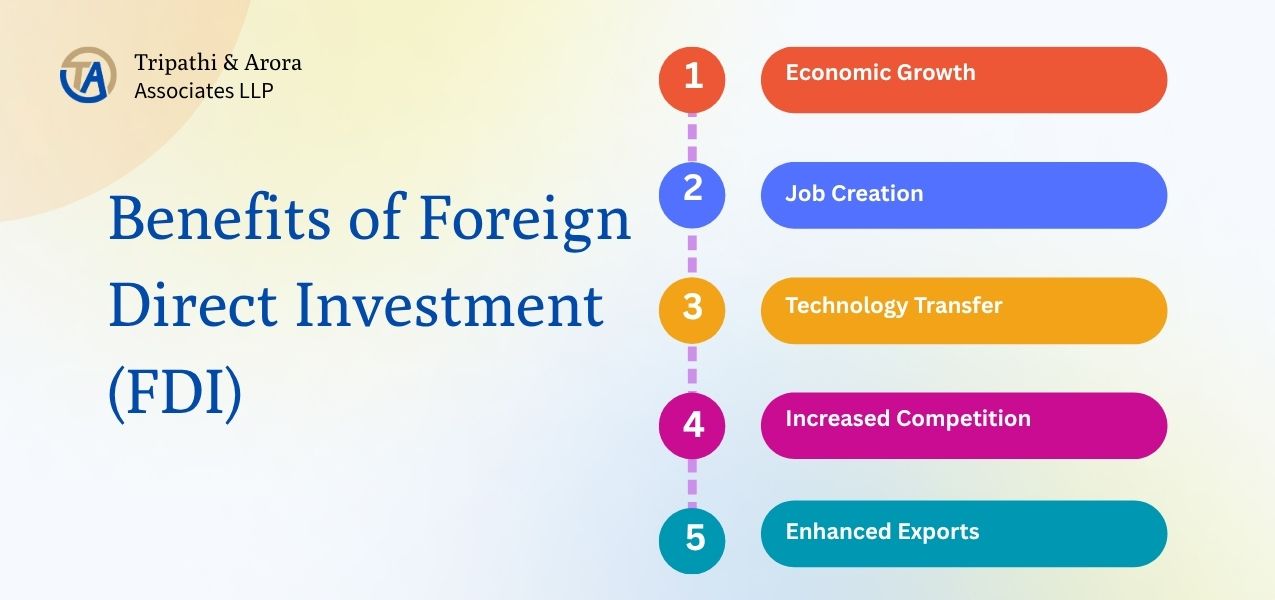
Economic Growth
FDI contributes to economic growth by providing capital for investment in infrastructure and industries. It enhances productivity and creates jobs.Job Creation
Foreign investments lead to the establishment of new businesses and the expansion of existing ones, resulting in job creation across various sectors.Technology Transfer
FDI often brings advanced technologies and management practices to the host country, improving productivity and innovation.Increased Competition
The entry of foreign companies fosters competition in the domestic market, leading to better products and services for consumers.Enhanced Exports
FDI can enhance a country's export capabilities by providing access to international markets and networks.Challenges of Foreign Direct Investment (FDI)

Regulatory Hurdles
Despite liberalization, foreign investors often face regulatory challenges, including complex approval processes and compliance requirements.Political Risks
Political instability and changes in government policies can affect the investment climate, creating uncertainty for foreign investors.Cultural Differences
Understanding local culture and business practices is crucial for foreign investors. Misalignment can lead to challenges in operations and management.Infrastructure Issues
Inadequate infrastructure can hinder the effectiveness of foreign investments, particularly in sectors requiring robust logistical support.FDI Regulations in India
Government Policies
The Indian government has established various policies to regulate FDI, including the Foreign Exchange Management Act (FEMA) and the Foreign Direct Investment Policy.Sectors Open for FDI
India allows FDI in various sectors, including:- Manufacturing
- Information Technology
- Telecommunications
- Retail
- Healthcare
Approval Process
FDI can be routed through two channels: the automatic route and the government route. The automatic route allows foreign investors to invest without prior approval, while the government route requires approval from the Foreign Investment Promotion Board (FIPB).FDI and Economic Development
1. Impact on GDP
FDI significantly contributes to India’s GDP, enhancing overall economic growth. It provides the necessary capital for development projects and infrastructure.2. Regional Development
FDI helps in reducing regional disparities by promoting investment in less developed areas. This leads to balanced economic development across the country.3. Skill Development
Foreign companies often invest in training and development programs for local employees, enhancing the skill set of the workforce and contributing to human capital development.Case Studies
Successful FDI Examples in India
- Samsung India: The establishment of manufacturing facilities in India has created thousands of jobs and contributed significantly to the electronics sector.
- Honda Motor Co.: Honda’s investment in manufacturing facilities has not only created jobs but also enhanced the automotive industry in India.
Challenges Faced by Foreign Investors
- Walmart: Faced regulatory hurdles and challenges in adapting to local retail practices, highlighting the complexities of entering the Indian market.
- Uber: Navigated various regulatory challenges and competition from local players, emphasizing the need for a deep understanding of the market landscape.

Future of FDI in India
Emerging Trends
The future of FDI in India looks promising, with increasing interest from foreign investors in areas like:- Startups: The startup ecosystem in India is thriving, attracting significant foreign investments.
- Renewable Energy: With a focus on sustainable development, investments in renewable energy are on the rise.
- Digital Transformation: The digital economy is witnessing rapid growth, leading to increased investments in technology and innovation.
Government Initiatives
The Indian government continues to promote FDI through various initiatives aimed at improving the investment climate and simplifying regulations.Conclusion
Foreign Direct Investment is a crucial driver of economic growth and development in India. It brings numerous benefits, including capital infusion, technology transfer, and job creation. However, foreign investors must navigate regulatory challenges and cultural differences to succeed in the Indian market.At Tripathi & Arora Associates, we are dedicated to providing comprehensive advisory services to help businesses understand and leverage FDI opportunities in India.Whether you are a foreign investor looking to enter the Indian market or a local business seeking to attract foreign investment, our expertise can guide you in making informed decisions.
If you have any questions about FDI or need assistance, please contact us today!
FAQ Foreign Direct Investment
1. What are the 4 types of foreign direct investment?
By understanding the four main FDI types – horizontal, vertical, conglomerate, and platform – you can tailor your investment strategy to specific goals.2. What is the FDI limit in India?
The FDI limit in India is generally 100% under the automatic route for most sectors, except certain strategically sensitive sectors which have specific caps (e.g., insurance now proposed at 100%, private banking at 74%, public banking at 20%)3. How are profits repatriated from FDI?
Foreign investors can repatriate profits after paying applicable taxes, following the regulations set by the RBI and the host country's laws.4. What is Foreign Direct Investment (FDI)?
FDI refers to the investment made by a company or individual in one country in business interests in another country, typically by establishing business operations or acquiring assets.Other Related Links
- Incorporation Service
- Private Limited Company Registration
- Limited Liability Partnership Company Registration
- One Person Company Registration
- Partnership Company Registration
- Trademark Registration Service
- Income Tax Return Filing Services
- GST Return Filing Services
- FEMA/FDI Services
- Business Registration Solutions
- Accounting And Taxation Services
- Virtual CFO Services
- Secreterial Compliances Services
- Drafting Services


