Introduction to Tax Regimes
In February 2020, the Finance Minister introduced a new tax regime under the Income Tax Act, giving taxpayers an option to choose between the old regime with deductions and exemptions and the new regime with lower tax rates but without most deductions.
Overview of the Old Tax Regime
The old tax regime allows taxpayers to claim various deductions and exemptions, which can significantly reduce taxable income. Key features include:
- Deductions: Taxpayers can claim deductions under sections such as 80C (investments in PPF, ELSS, etc.), 80D (health insurance premiums), and 24(b) (home loan interest).
- Exemptions: Certain allowances like House Rent Allowance (HRA), Leave Travel Allowance (LTA), and others are exempt from tax.
- Tax Slabs: The old regime has multiple tax slabs, which can lead to higher tax rates for higher income brackets.
Overview of the New Tax Regime
The new tax regime was introduced to simplify the tax structure and encourage compliance. Key features include:
- Lower Tax Rates: The new regime offers reduced tax rates across different income slabs.
- Fewer Deductions: Most deductions and exemptions available in the old regime are not applicable, making it easier to calculate tax liability.
- Tax Slabs: The new regime features a different set of tax slabs with lower rates.
Comparative Analysis
1. Tax Rates
The following table illustrates the tax rates under both regimes:
| Income Range (₹) |
Old Regime Tax Rate |
New Regime Tax Rate |
| 0 - 2.5 lakh |
Nil |
Nil |
| 2.5 - 5 lakh |
5% |
5% |
| 5 - 10 lakh |
20% |
10% |
| Above 10 lakh |
30% |
30% |
2. Deductions and Exemptions
Old Regime:
- Allows for various deductions, which can lower taxable income significantly.
- Popular sections include 80C, 80D, and 24(b).
New Regime:
- Most deductions and exemptions are eliminated to simplify the process.
- Only a few deductions, such as NPS contributions, remain applicable.
3. Compliance and Complexity
- Old Regime: More complex due to the need to track and claim various deductions and exemptions.
- New Regime: Simplified compliance, making it easier for taxpayers to calculate their liabilities without extensive documentation.
4. Eligibility Criteria
Both regimes can be chosen by individual taxpayers and Hindu Undivided Families (HUFs), but certain conditions may apply, especially for taxpayers with business income.
5. Impact on Taxable Income
The choice between the two regimes will largely depend on your income level and the deductions you are eligible to claim.
Example Scenario:
- Taxpayer A:
- Income: ₹12 lakh
- Deductions claimed under the old regime: ₹2 lakh (80C, 80D)
Old Regime Tax Calculation:
- Taxable Income: ₹12 lakh - ₹2 lakh = ₹10 lakh
- Tax:
- 0 - 2.5 lakh: Nil
- 2.5 - 5 lakh: ₹12,500
- 5 - 10 lakh: ₹1,00,000
- Total Tax: ₹1,12,500
New Regime Tax Calculation:
- Taxable Income: ₹12 lakh
- Tax:
- 0 - 2.5 lakh: Nil
- 2.5 - 5 lakh: ₹12,500
- 5 - 10 lakh: ₹50,000
- 10 lakh and above: ₹60,000
- Total Tax: ₹1,22,500
In this example, Taxpayer A would benefit from the old regime.
Factors to Consider When Choosing
1. Income Level
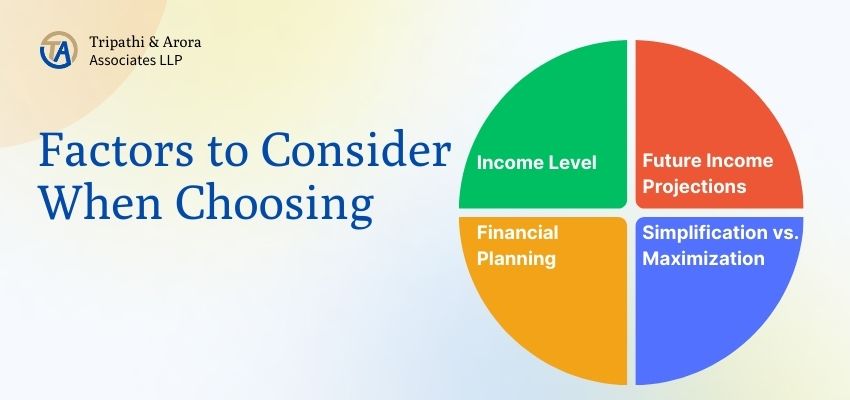
Higher income levels may benefit more from the old regime due to the ability to claim more deductions, while lower-income individuals might find the new regime more beneficial due to its simplicity.
2. Financial Planning
Consider your financial goals and investments. If you are investing in tax-saving instruments, the old regime may be more advantageous.
3. Future Income Projections
If you anticipate an increase in income, consider how each regime will impact your tax liabilities in the future.
4. Simplification vs. Maximization
Decide whether you prefer a simplified process with the new regime or the potential for lower taxes through deductions in the old regime.
Conclusion
Choosing between the new tax regime and the existing old regime ultimately depends on individual circumstances, including income level, eligible deductions, and personal financial goals.
To make the best decision:
- Calculate Your Tax Liability: Use both regimes to see which results in a lower tax.
- Consider Long-term Financial Implications: Think about your future investments and income.
- Consult a Financial Advisor: For personalized advice, consider consulting a tax professional.
By understanding the nuances of both tax regimes, you can optimize your tax planning and make an informed choice that aligns with your financial objectives.