#1How to Become a Director of a Company in India 2026
Posted By: Admin Published: 11-06-2026

Table of Contents
- 2.1. 1. Age Requirement
- 2.2. 2. Educational Qualifications
- 2.3. 3. Director Identification Number (DIN)
- 2.4. 4. Not Disqualified
- 3.1. Step 1: Obtain a Director Identification Number (DIN)
- 3.2. Step 2: Understand the Roles and Responsibilities
- 3.3. Step 3: Acceptance of Appointment
- 3.4. Step 4: Filing with the Registrar of Companies (ROC)
- 3.5. Step 5: Comply with Additional Requirements
- 4.1. 1. Strategic Planning
- 4.2. 2. Financial Oversight
- 4.3. 3. Compliance
- 4.4. 4. Corporate Governance
- 4.5. 5. Decision-Making
- 4.6. 6. Performance Monitoring
- 4.7. 7. Stakeholder Communication
- 4.8. 8. Team Leadership
- 4.9. 9. Risk Management
- 4.10. 10. Succession Planning
- 4.11. 11. Meetings and Reporting
- 9.1. Q1. Who can be a director of a company?
- 9.2. Q2. What are the director requirements in India?
- 9.3. Q3. Who is eligible to become a director?
- 9.4. Q4. How to become a director of a company in India?
- 9.5. Q5. Who may be appointed as a director of a company?
Becoming a director of a company in India is a significant milestone that involves understanding legal requirements, responsibilities, and the governance structure of companies. Directors play a vital role in shaping the policies, strategies, and overall direction of a company. This comprehensive guide will explore the qualifications, legal framework, responsibilities, and steps involved in becoming a director of a company in India.
What is a Director?
A director is an individual appointed to the board of a company who is responsible for overseeing the management and operations of the business. Directors play a crucial role in decision-making, strategic planning, and ensuring compliance with legal obligations.Types of Directors
In India, companies can have various types of directors based on their roles and responsibilities. Here are the main types of directors:- Managing Director (MD)
- Responsible for the day-to-day operations and management of the company.
- Whole-time Director
- A director who is in full-time employment of the company and has specific responsibilities as assigned by the board.
- Executive Director
- Involved in the daily operations and management of the company, often with specific areas of responsibility.
- Non-Executive Director
- Not involved in the daily operations; provides oversight and strategic guidance.
- Independent Director
- A non-executive director who is independent of the management and has no substantial financial interest in the company, ensuring unbiased judgment.
- Additional Director
- Appointed by the board of directors to fill a vacancy or for a specific period.
- Alternate Director
- Appointed to act in place of a director who is absent for a specified period.
- Director for a Specific Purpose
- Appointed for a specific task or project, usually temporary.
- Nominee Director
- Appointed to represent the interests of a shareholder or a group of shareholders.
- Resident Director
- A director who resides in India and is responsible for ensuring compliance with Indian laws.
Legal Framework Governing Directors in India
Companies Act, 2013
The primary legislation governing the appointment and responsibilities of directors in India is the Companies Act, 2013. Key provisions include:- Eligibility Criteria: Defines who can become a director, including age limits and disqualifications.
- Appointment: Outlines the process for appointing directors, including the need for a resolution and approval by shareholders.
- Duties and Responsibilities: Specifies the duties of directors, including fiduciary responsibilities and compliance with legal obligations.
Ministry of Corporate Affairs (MCA)
The MCA regulates corporate affairs in India, including the registration of directors. All directors must comply with the regulations and guidelines set forth by the MCA.Qualifications to Become a Director
1. Age Requirement
To be eligible for appointment as a director, an individual must be at least 18 years of age.2. Educational Qualifications
While there are no specific educational qualifications mandated by law to become a director, having a degree in business, finance, law, or a related field can be advantageous. Additionally, relevant experience in the industry can enhance credibility.3. Director Identification Number (DIN)
Every individual intending to become a director must obtain a Director Identification Number (DIN) from the MCA. This unique identification number is essential for all directors and is mandatory for filing documents with the MCA.4. Not Disqualified
Certain individuals are disqualified from becoming directors, including:- Individuals convicted of any offense involving fraud or dishonesty.
- Individuals declared insolvent or bankrupt.
- Individuals of unsound mind as declared by a competent authority.
- Individuals who have served as directors of companies that have been disqualified.
Steps to Become a Director of a Company
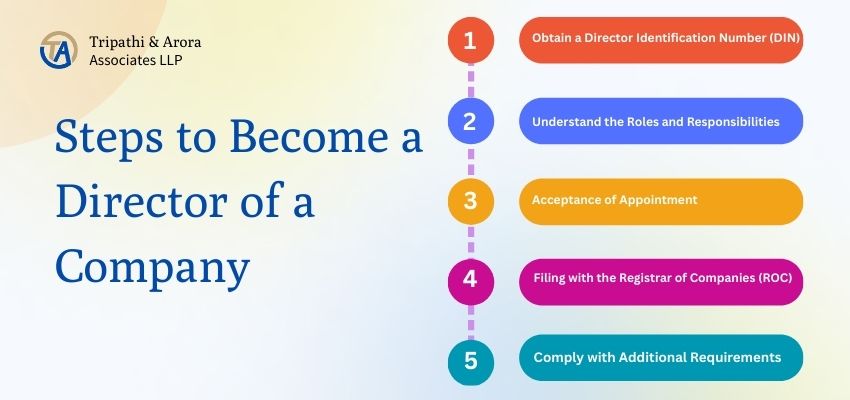
Step 1: Obtain a Director Identification Number (DIN)
The first step towards becoming a director is to obtain a DIN. The process involves:- Fill out Form DIR-3: Visit the MCA website and fill out Form DIR-3. This form is used to apply for a DIN.
- Attach Required Documents: Submit identity proof (such as a PAN card or passport) and address proof (such as a utility bill or bank statement).
- Submit the Application: The form can be submitted online, and there is a nominal fee for obtaining a DIN.
- Receive the DIN: On successful verification, you will receive your DIN via email.
Step 2: Understand the Roles and Responsibilities
Before accepting a position as a director, it is essential to understand the responsibilities involved. Key duties include:- Fiduciary Duty: Acting in the best interests of the company and its stakeholders.
- Compliance: Ensuring that the company complies with all applicable laws and regulations.
- Financial Oversight: Reviewing financial statements and ensuring accurate reporting.
- Strategic Planning: Participating in the formulation of the company’s strategy and policies.
Step 3: Acceptance of Appointment
Once you are nominated for the position of director:- Board Resolution: The appointment should be formalized through a board resolution if you are appointed as an executive director.
- Consent to Act as Director: You must provide written consent to act as a director, which should be submitted to the company.
Step 4: Filing with the Registrar of Companies (ROC)
After your appointment, the company must file the necessary forms with the ROC:- Form DIR-12: The company must file Form DIR-12 to notify the ROC of your appointment as a director. This should be done within 30 days of your appointment.
- Attach Supporting Documents: Include your DIN, consent letter, and board resolution with the filing.
Step 5: Comply with Additional Requirements
Depending on the company’s structure and your role, you may need to comply with additional requirements:- Independent Directors: If you are appointed as an independent director, you must comply with additional provisions related to independence and attend training sessions as required.
- Director’s Report: Participate in the preparation of the director’s report and ensure it meets legal requirements.
Major Roles and Responsibilities of Directors in a Private Limited Company
Directors in a private limited company play crucial roles in governance and management. Here are the major roles and responsibilities:1. Strategic Planning
- Develop and implement the company’s strategic goals and objectives.
- Ensure the company's long-term sustainability and growth.
2. Financial Oversight
- Approve budgets, financial statements, and major expenditures.
- Ensure proper use of company resources and maintain financial integrity.
3. Compliance
- Ensure adherence to legal and regulatory requirements.
- Maintain compliance with the Companies Act and other applicable laws.
4. Corporate Governance
- Uphold ethical standards and ensure transparency in decision-making.
- Establish policies for risk management and internal control.
5. Decision-Making
- Make key decisions regarding company operations, including hiring and firing of senior management.
- Evaluate and approve significant contracts and agreements.
6. Performance Monitoring
- Monitor the performance of the company against its strategic goals.
- Assess the effectiveness of management and operational efficiency.
7. Stakeholder Communication
- Engage with shareholders, employees, and other stakeholders.
- Provide clear communication regarding company performance and strategies.
8. Team Leadership
- Lead and support the management team in executing the company’s strategy.
- Foster a positive corporate culture and employee engagement.
9. Risk Management
- Identify potential risks and develop strategies to mitigate them.
- Ensure that the company has appropriate insurance coverage.
10. Succession Planning
- Plan for future leadership needs and develop talent pipelines.
- Ensure continuity of management and operations.
11. Meetings and Reporting
- Organize and attend board meetings, ensuring effective communication and documentation.
- Report to shareholders and stakeholders on company performance.
what documents are needed to appoint a director?
To successfully appoint a new director under the Companies Act, 2013, the company must collect and submit the following documents:- PAN Card – Mandatory for identity verification and income tax records.
- Identification Proof – Voter ID, Driving License, or Aadhaar Card to establish legal identity.
- Proof of Residence – Utility bills, rental agreements, or bank statements to confirm the residential address.
- Passport-Size Photograph – Required for official records and filings.
- Digital Signature Certificate (DSC) – A mandatory encrypted digital key to sign e-forms and documents filed with the MCA. Without it, a director cannot file essential forms like DIR-12, annual returns, or financial statements.
- Form DIR-2 (Consent to Act as Director) – Written consent confirming the individual’s willingness to act as a director.
- Form MBP-1 (Disclosure of Interest) – Mandatory after appointment to disclose any interests in other entities.
Rights and Duties of Directors
Rights of Directors
- Access to Information: Directors have the right to access all company documents and records necessary for making informed decisions.
- Participation in Meetings: Directors can attend and participate in board meetings and general meetings of the company.
- Remuneration: Directors are entitled to receive remuneration as approved by the company’s shareholders.
Duties of Directors
- Duty of Care: Directors must act with due diligence and care while making decisions.
- Duty of Loyalty: Directors must act in the best interests of the company and avoid conflicts of interest.
- Duty to Act in Good Faith: Directors should act in good faith and with honesty while performing their duties.
Disqualification of Directors
Certain circumstances may lead to disqualification as a director. These include:- Conviction: Being convicted of any offense involving moral turpitude.
- Insolvency: Being declared insolvent or bankrupt.
- Non-Compliance: Failing to comply with the provisions of the Companies Act or other applicable laws.

Consequences of Non-Compliance
Failure to comply with the duties and responsibilities of a director can result in severe consequences:- Legal Action: Directors may face legal action for breach of fiduciary duty or non-compliance with laws.
- Personal Liability: In certain cases, directors may be held personally liable for the company’s debts if they have acted negligently or fraudulently.
- Disqualification: Directors may be disqualified from serving on the board of any company if found guilty of misconduct.
Conclusion
Becoming a director of a company in India is a rewarding but demanding role that comes with significant responsibilities and legal obligations. Understanding the qualifications, legal requirements, and responsibilities associated with the position is crucial for anyone aspiring to become a director. By following the outlined steps and ensuring compliance with the legal framework, individuals can successfully navigate the process and contribute positively to the company’s growth and success.If you have any questions or need further assistance in your journey to becoming a director, feel free to reach out. Your role as a director can significantly impact the company and its stakeholders, making it a vital position in the corporate world!
FAQ
Q1. Who can be a director of a company?
Both Indian citizens and foreign nationals can be directors of a company in India, provided they have a valid DIN and meet the prescribed compliance requirements.Q2. What are the director requirements in India?
The key requirements for a director include being a natural person, having a valid DIN, DSC, and fulfilling the eligibility criteria laid out in the Companies Act, 2013.Q3. Who is eligible to become a director?
Any person over 18 years of age, with no criminal disqualification or insolvency record, is eligible to become a director in India.Q4. How to become a director of a company in India?
To become a director in an Indian company, an individual must obtain a Director Identification Number (DIN) and be appointed by the company through a board or shareholder resolution. Eligibility includes being at least 18 years old and not disqualified by law.Q5. Who may be appointed as a director of a company?
Any individual who is at least 18 years old, of sound mind, and not disqualified under the Companies Act may be appointed as a director of a company. Both Indian citizens and foreign nationals can be appointed if they have a valid Director Identification Number (DIN).Other Related Links
- Incorporation Service
- Private Limited Company Registration
- Limited Liability Partnership Company Registration
- One Person Company Registration
- Partnership Company Registration
- Trademark Registration Service
- Income Tax Return Filing Services
- GST Return Filing Services
- FEMA/FDI Services
- Business Registration Solutions
- Accounting And Taxation Services
- Virtual CFO Services
- Secreterial Compliances Services
- Drafting Services


