Difference Between Private Limited Company and LLP in India (2026)
Posted By: Admin Published: 19-05-2026

- 1. Introduction: What Are Private Limited Company and LLP?
- 2. Advantages and Disadvantages
- 3. Which One Should You Choose?
- 4. Taxation Comparison
- 5. Compliance Requirements
- 6. Registration Process Comparison
- 7. Which is Better for Startups?
- 8. Can You Convert LLP to Private Limited Company (or Vice Versa)?
- 9. Conclusion: Final Recommendation
- 10. FAQs
- 10.1. Q1. Which is cheaper to maintain: Pvt. Ltd. or LLP?
- 10.2. Q2. Can an LLP issue shares?
- 10.3. Q3. Do I need a physical office for Pvt. Ltd. or LLP?
- 10.4. Q4. Can a single person start a Pvt. Ltd. or LLP?
- 10.5. Q5. Which is better for GST registration?
- 10.6. Q6. Can NRIs or foreign nationals be partners in an LLP?
Choosing the right business structure is one of the most critical decisions for entrepreneurs in India. Two of the most popular options are Private Limited Companies (Pvt. Ltd.) and Limited Liability Partnerships (LLP). Both offer limited liability protection but differ significantly in terms of ownership, compliance, taxation, and scalability.
If you're confused about which structure suits your business needs, this guide will help you understand the key differences between a Private Limited Company and an LLP in India.
Introduction: What Are Private Limited Company and LLP?
Private Limited Company (Pvt. Ltd.)
A Private Limited Company is a type of business entity registered under the Companies Act, 2013. It is a separate legal entity from its shareholders, offering limited liability protection—meaning the personal assets of shareholders are not at risk in case of business debts or losses.- Ownership: Owned by 2 to 200 shareholders (as per the Companies Act, 2013).
- Management: Managed by directors (minimum 2, maximum 15).
- Liability: Limited to the extent of shares held by each shareholder.
Limited Liability Partnership (LLP)
An LLP is a hybrid business structure that combines the benefits of a partnership firm and a company. It is governed by the Limited Liability Partnership Act, 2008 and provides limited liability protection to its partners.- Ownership: Owned by 2 or more partners (no upper limit).
- Management: Managed by designated partners (minimum 2).
- Liability: Limited to the extent of their capital contribution in the LLP.
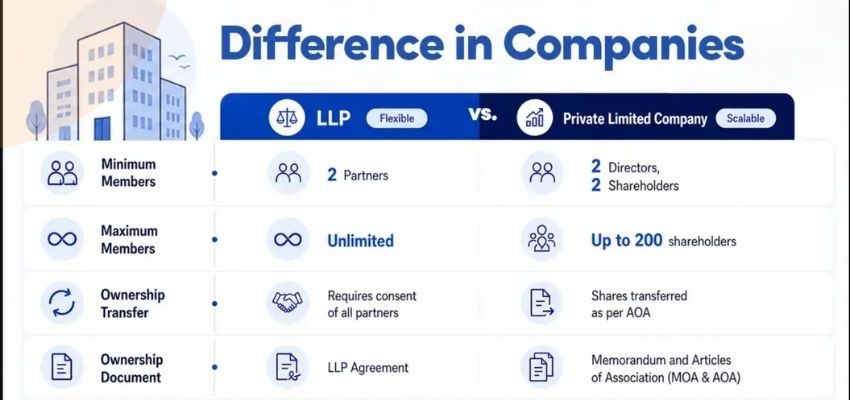
| Feature | Private Limited Company | Limited Liability Partnership (LLP) |
|---|---|---|
| Governing Act | Companies Act, 2013 | LLP Act, 2008 |
| Minimum Members | 2 Shareholders | 2 Partners |
| Maximum Members | 200 Shareholders | No Upper Limit |
| Liability | Limited to shares held | Limited to capital contribution |
| Management | Directors (Min. 2) | Designated Partners (Min. 2) |
| Ownership Transfer | Easy (via share transfer) | Difficult (requires LLP agreement change) |
| Compliance Requirements | High (Annual filings, audits, board meetings) | Low (Only annual filings) |
| Taxation | 30% + Surcharge + Cess (Corporate Tax) | 30% + Surcharge + Cess (Slab-based for partners) |
| Dividend Distribution Tax (DDT) | Applicable (15%) | Not Applicable |
| Foreign Investment | Allowed (FDI permitted) | Allowed (with RBI approval) |
| Audit Requirement | Mandatory (if turnover > ₹2 Cr) | Mandatory (if turnover > ₹40 Lakh or capital > ₹25 Lakh) |
| Cost of Registration | Higher (₹10,000 - ₹20,000) | Lower (₹5,000 - ₹10,000) |
| Fundraising | Easier (VCs, Angel Investors prefer Pvt. Ltd.) | Difficult (Investors prefer Pvt. Ltd.) |
| Perpetual Succession | Yes (Company continues even if members change) | Yes (LLP continues even if partners change) |
Advantages and Disadvantages
Private Limited Company
✅ Pros:- Better for fundraising (Investors prefer Pvt. Ltd. for equity funding).
- Easier ownership transfer (Shares can be sold or transferred).
- Higher credibility (Trusted by banks, vendors, and customers).
- Perpetual existence (Company continues even if directors/shareholders change).
- Higher compliance (More legal formalities, audits, and filings).
- Higher registration cost (Compared to LLP).
- Strict regulations (More government oversight).
Limited Liability Partnership (LLP)
✅ Pros:- Lower compliance (Fewer legal formalities).
- No Dividend Distribution Tax (DDT) (Partners pay tax as per their slab).
- Flexible management (Partners can manage as per LLP agreement).
- Lower registration cost (Cheaper than Pvt. Ltd.).
- Harder to raise funds (Investors prefer Pvt. Ltd. for equity).
- Difficult ownership transfer (Requires amending LLP agreement).
- Less credibility (Some banks and vendors prefer Pvt. Ltd.).
Which One Should You Choose?
Go for a Private Limited Company If:
✔ You plan to raise venture capital or angel investment.✔ You want easier ownership transfer (selling shares).
✔ You need higher credibility (for banks, suppliers, and customers).
✔ You expect high growth and scalability.
Go for an LLP If:
✔ You want lower compliance and costs.✔ You are a small business or professional firm (e.g., CA, lawyers, consultants).
✔ You don’t need external funding (self-funded or bootstrapped).
✔ You prefer flexible management (partners can define roles in the agreement).
Taxation Comparison
| Aspect | Private Limited Company | LLP |
|---|---|---|
| Income Tax Rate | 30% + Surcharge + Cess (Flat rate) | 30% + Surcharge + Cess (Partners pay tax as per slab) |
| Dividend Tax | 15% DDT (on declared dividends) | No DDT (Partners pay tax on profit share) |
| Minimum Alternate Tax (MAT) | Applicable (18.5% of book profits) | Not Applicable |
| Capital Gains Tax | Applicable on share transfers | Applicable on partner exit |
- Pvt. Ltd. pays corporate tax on profits, and shareholders pay additional tax on dividends.
- LLP is tax-transparent—profits are taxed in the hands of partners as per their income slab.
Compliance Requirements
Private Limited Company Compliance
- Annual Filings: MGT-7 (Annual Return), AOC-4 (Financial Statements).
- Board Meetings: Minimum 4 per year (with a max gap of 120 days).
- Audit: Mandatory if turnover exceeds ₹2 Crore.
- Other Filings: DIN KYC, DIR-3 KYC, MSC-1 (for foreign subsidiaries).
LLP Compliance
- Annual Filings: Form 11 (Annual Return), Form 8 (Statement of Accounts).
- Audit: Mandatory if turnover > ₹40 Lakh or capital > ₹25 Lakh.
- No Board Meetings Required (Only partner meetings as per agreement).
Registration Process Comparison
| Step | Private Limited Company | LLP |
|---|---|---|
| Digital Signature Certificate (DSC) | Required for Directors | Required for Designated Partners |
| Director Identification Number (DIN) | Required for Directors | Required for Designated Partners |
| Name Approval (RUN) | Apply via RUN (Reserve Unique Name) | Apply via LLP-RUN |
| Incorporation Form | SPICe+ (INC-32) | FiLLiP (Form for LLP Registration) |
| PAN & TAN | Automatically allotted | Automatically allotted |
| Time Taken | 10-15 days | 7-10 days |
| Cost | ₹10,000 - ₹20,000 | ₹5,000 - ₹10,000 |
Which is Better for Startups?
| Factor | Private Limited Company | LLP |
|---|---|---|
| Investor Appeal | ✅ High (VCs prefer Pvt. Ltd.) | ❌ Low |
| Compliance Burden | ❌ High | ✅ Low |
| Cost of Setup | ❌ High | ✅ Low |
| Scalability | ✅ High | ❌ Limited |
| Tax Benefits | ❌ DDT Applicable | ✅ No DDT |
- If you're a tech startup, SaaS business, or planning to raise funds, Private Limited Company is the best choice.
- If you're a small business, freelancer, or professional service provider, LLP is more cost-effective and flexible.
Can You Convert LLP to Private Limited Company (or Vice Versa)?
✅ Yes! You can convert:- LLP to Pvt. Ltd. (Under Companies Act, 2013).
- Pvt. Ltd. to LLP (Under LLP Act, 2008).
- Pass a special resolution (for Pvt. Ltd. to LLP).
- File necessary forms with ROC (Registrar of Companies).
- Obtain NOC from creditors and tax authorities.
- New registration under the respective Act.
Conclusion: Final Recommendation
| Business Type | Recommended Structure |
|---|---|
| Startups (Tech, SaaS, E-commerce) | Private Limited Company |
| Professional Services (CA, Lawyers, Consultants) | LLP |
| Small Businesses (Low Compliance Needed) | LLP |
| High-Growth Companies (Funding Needed) | Private Limited Company |
- If you plan to scale fast and raise funds, go for a Private Limited Company.
- If you want lower costs and simpler compliance, LLP is the way to go.
FAQs
Q1. Which is cheaper to maintain: Pvt. Ltd. or LLP?
LLP is cheaper due to lower compliance and audit requirements.Q2. Can an LLP issue shares?
No, LLPs cannot issue shares. Ownership is based on capital contribution.Q3. Do I need a physical office for Pvt. Ltd. or LLP?
Yes, a registered office address is mandatory for both.Q4. Can a single person start a Pvt. Ltd. or LLP?
- Pvt. Ltd. requires minimum 2 shareholders.
- LLP requires minimum 2 partners.
- For single-person businesses, consider One Person Company (OPC).


