Understanding the Startup Ecosystem in Gurgaon
Gurgaon, also known as Gurugram, is a thriving city in the National Capital Region (NCR) of India. It is home to numerous multinational corporations, startups, and innovation hubs. The city's infrastructure, access to talent, and proximity to Delhi make it an ideal location for startups.
Benefits of Registering a Startup
- Legal Recognition: Official registration provides your startup with legal recognition, enhancing credibility.
- Access to Funding: Registered startups can access various funding options, including government schemes and investor funding.
- Tax Benefits: Startups may qualify for tax exemptions under certain government initiatives.
- Limited Liability: Depending on the structure, registration can protect personal assets from business liabilities.
Read More:
Step-by-Step Online Company Registration Process in Gurgaon
Step-by-Step Process to Register a Startup
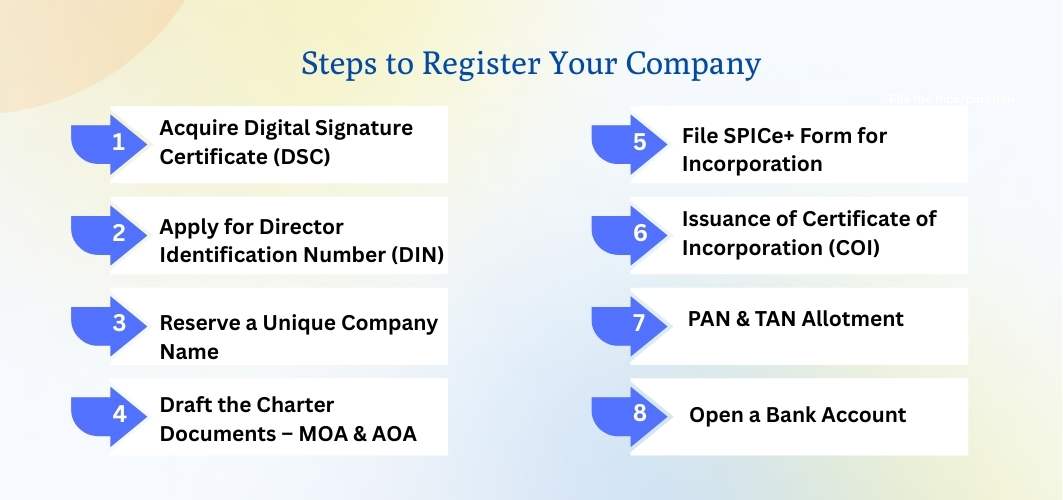
Step 1: Acquire Digital Signature Certificate (DSC)
To begin the
incorporation journey, obtaining a Class 3 Digital Signature Certificate is a mandatory requirement for all individuals proposed to act as directors or shareholders. This certificate is used to electronically sign incorporation forms and other filings submitted to the Ministry of Corporate Affairs (
MCA). It can be procured through MCA-authorized certifying authorities.
Step 2: Apply for Director Identification Number (DIN)
Every person intending to become a director in an Indian company must possess a Director Identification Number (DIN). When incorporating a new company, DINs for up to three directors can be requested directly within the SPICe+ (INC-32) form. Those who already hold a DIN can use the same in the registration application.
Step 3: Reserve a Unique Company Name
Selection of a company name is a crucial step and must be compliant with the naming guidelines under the Companies (Incorporation) Rules, 2014. The proposed name must be neither identical nor too similar to existing names. Name reservation is done through Part A of the SPICe+ web form, and the government fee for filing is ₹1,000 per application.
Step 4: Draft the Charter Documents – MOA & AOA
-
The Memorandum of Association (MOA) and Articles of Association (AOA) are foundational documents defining the company’s scope and internal governance. For most cases, these are filed electronically through e-MOA (INC-33) and e-AOA (INC-34). If any subscriber is based outside India or if there are more than seven subscribers, physical execution may be required.
-
The SPICe+ (Simplified Proforma for Incorporating a Company Electronically Plus) form is the comprehensive application for registration. It integrates various services such as:
-
- Company incorporation
- DIN allotment
- PAN and TAN issuance
- GSTIN, EPFO, and ESIC registrations
- Professional Tax registration (in applicable states)
- Opening of a business bank account
Supporting documents typically include:
-
- Identity and address proof of directors and subscribers
- Proof of registered office (rent agreement/NOC + utility bill)
- Form DIR-2 (consent from directors)
- Form INC-9 (declaration by subscribers and directors)
- INC-8 declaration by a professional (if applicable)
Step 6: Issuance of Certificate of Incorporation (COI)
Upon successful processing and approval by the Registrar of Companies (RoC), a Certificate of Incorporation (Form INC-11) is issued digitally. This certificate confirms the legal existence of the company and includes the Corporate Identification Number (CIN). The date mentioned on the certificate is the official date of incorporation.
Step 7: PAN & TAN Allotment
As part of the SPICe+ integration, Permanent Account Number (PAN) and Tax Deduction and Collection Account Number (
TAN) are automatically generated and issued by the Income Tax Department. These documents are digitally delivered, and physical copies are dispatched to the registered office address.
Step 8: Open a Current Bank Account
Once the company receives the Certificate of Incorporation along with PAN and TAN, it must open a current account with a scheduled bank in the company’s name. Documents typically required by banks include:
- COI
- PAN
- MOA and AOA
- Board resolution authorizing account opening
Step 9: Comply with Post-Incorporation Requirements
After incorporation, several legal and regulatory requirements must be followed under the Companies Act, 2013:
- Appoint a statutory auditor within 30 days (via Board Resolution)
- File annual returns (Form MGT-7) and financial statements (Form AOC-4)
- Conduct Board Meetings as per Section 173 and maintain statutory registers
- File commencement of business declaration in Form INC-20A (if applicable to a company having share capital)
Common Challenges in Startup Registration
.jpg?1=&directory=catalog "Common Challenges in Startup Registration")
1. Complexity of Regulatory Requirements
Navigating the regulatory landscape can be overwhelming for first-time entrepreneurs. Understanding the documentation and compliance requirements is essential.
2. Time Constraints
The registration process may take time, especially if additional information or corrections are needed. Planning ahead is crucial to avoid delays.
3. Name Availability Issues
Finding a unique name that complies with regulations can be challenging. Conduct thorough searches to avoid rejections.
4. Documentation Errors
Incomplete or incorrect documentation can lead to delays in the registration process. Ensure all documents are accurate and properly organized.
How Tripathi & Arora Associates LLp Can Help You in Company Registration In Gurgaon?
It can be challenging and time-consuming to register a startup in Gurgaon. Thus, our professionals at Tripathi & Arora Associates LLp can offer you experience and direction based on their years of experience. From the documentation process to the strategic planning for the expansion of your company, we can assist you.
Our extensive understanding of legal frameworks and the sector can help you minimize legal compliance and achieve significant results quickly.
Are you prepared to work with Tripathi & Arora Associates LLp to grow your Gurgaon startup to new heights?
Conclusion
Registering a startup in Gurgaon is a crucial step toward establishing a successful business. By following the outlined steps and understanding the legal requirements, entrepreneurs can navigate the registration process effectively.
If you need assistance with startup registration or have specific queries, consider reaching out to Tripathi & Arora Associates. Our team of experts is dedicated to helping you establish your business and ensuring compliance with all regulatory requirements, paving the way for your entrepreneurial success.
Read More:
Company Registration Pvt Ltd
Frequently Asked Questions (FAQ)
1. What is the minimum number of directors required to register a Private Limited Company?
A minimum of two directors is required to register a Private Limited Company in India.
2. How long does it take to register a startup in Gurgaon?
The registration process typically takes 10 to 15 working days, depending on the completeness of the application and documents submitted.
3. Can a foreign national be a director in an Indian company?
Yes, a foreign national can be a director in an Indian company, but they must obtain a DIN and comply with applicable regulations.
4. Is it mandatory to have a registered office for a startup?
Yes, having a registered office is mandatory for all registered businesses in India.
5. What are the benefits of registering as a Private Limited Company?
Benefits include limited liability, enhanced credibility, easier access to funding, and tax advantages.
6. Can I change the name of my registered startup?
Yes, you can change the name of your registered startup by filing the necessary forms with the Registrar of Companies.
![How to Register a Startup in Gurgaon: A Step-by-Step Guide [2025]](https://ik.imagekit.io/fig/tr:w-1000,h-450/image/image_site151/catalog/HowtoRegisteraStartupinGurgaonAStep-by-StepGuide[2025].jpg "How to Register a Startup in Gurgaon: A Step-by-Step Guide [2025]")